


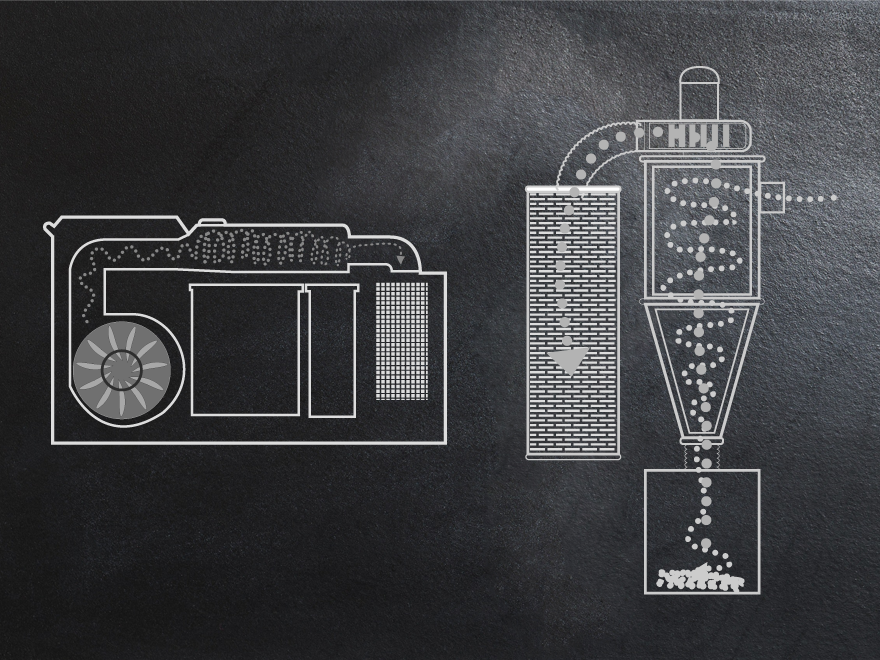
Cyclone separators work by utilizing the momentum of incoming particulates to mechanically separate materials of different densities--similar to how a centrifuge works. For woodworking dust collection, the inbound air velocity is used to literally spin the dust out of the air.
How a Cyclone’s Shape and Design Affect Separation Performance

For vertically-oriented cyclones, separation is greatly assisted by gravity pulling down on the heavier particulates, allowing the lighter air molecules to be carried back up through the center of the cyclone. The overall air performance of the system is not significantly affected (typically only 1 to 2" of additional static pressure) as the air interacts with only a minimal amount of other forces before reaching the fan blade. The more rotations the dust makes around the cyclone, the more dust is separated from the air.
For horizontally-oriented cyclones, the separation process is fighting against gravity half the time, as the dust spins up as it goes around. Rather than utilizing centrifugal forces, the dust must instead be separated via physical structures, such as fins and cavities, which increase the air resistance of the cyclone and reduce airflow performance overall.
Also, horizontal separators will typically have a discharge port underneath, allowing more dust laden air to be entrapped with the waste, as it cannot be physically separated prior to discharging. Such poor separation means dirty (rather than clean) air will make it to the motor and filter, degrading the system’s airflow performance overtime.
Increased Risk Of Damage To Impeller And Potential Spark Hazard
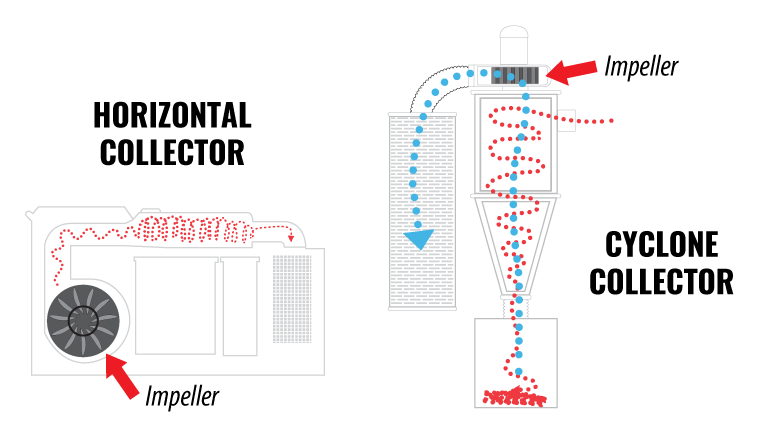
Another design drawback of most horizontally-orientated dust collectors is their positioning of the fan wheel before—rather than after—the separator. As debris both large and small enters the horizontal collector, it passes through the fan wheel. This exposes the impeller to a higher risk of damage from the bulkier, unseparated debris. It also increases the chances of an accidental spark if sucking up metal bolts, staples, or screws sometimes found in lumber.
In contrast, Oneida Air’s vertically-oriented cyclone collectors are designed to separate larger, heavier debris from the airstream before reaching the impeller. As material enters the cyclone, gravity pulls the nearly all debris down to the dust bin below, while centrifugal force spins a small fragment of the finest dust (which has very little chance of causing damage) up to the impeller. Since the cyclone prioritizes separation, there is also very little chance of stray metal introducing an accidental spark. Upon entering the cyclone, the heavier metal fragments will be separated out and succumb to gravity, avoiding the impeller entirely.
For any type of cyclone separator, the focus is to remove unwanted particulates without restricting the movement of the air. Vertically-oriented separators are the clear winner in this regard; and are considered the best practice in industry.
Significantly Increased Instances of Clogging
Because horizontally-oriented cyclone separators most typically rely on mechanical separation to create the spinning effect (rather than making use of natural forces like gravity), there is a significantly increased chance of material clogging the cyclone and reducing airflow to near zero. This risk becomes more prevalent with longer, "stringier" materials including wood shavings from planers, curls of epoxy-fills off of lathes, or even just general shop waste like paper scraps.
Longer strips of material can quickly can caught in the stationary fins of horizontal cyclones, cutting suction off and requiring a complete tear-down of the system for maintenance - eliminating any benefits that their less efficient separation performance would have netted originally.